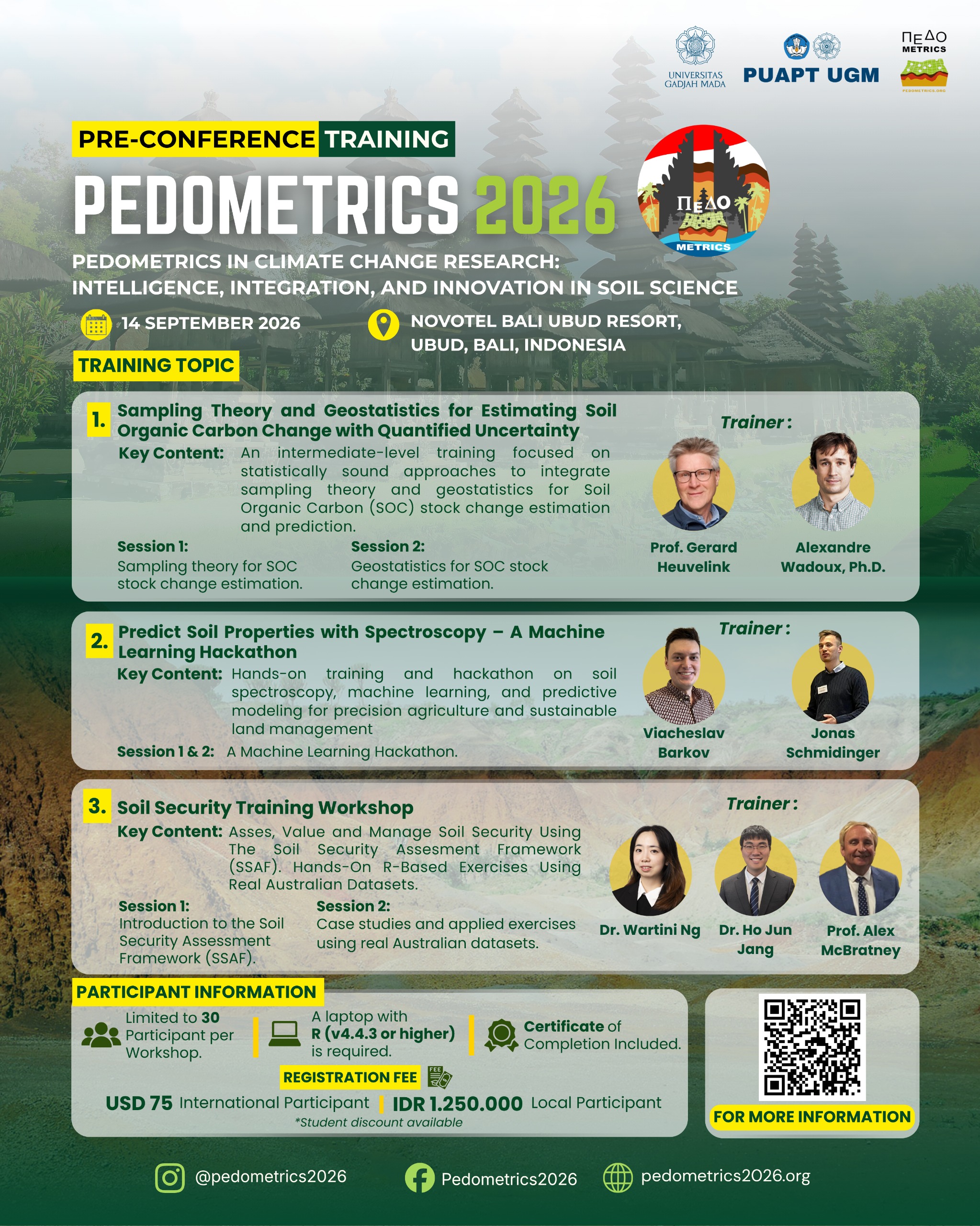
Pre-Conference Training
14 September 2026 (Fee USD 75/IDR 1,250,000)
Reserve your seat for the pre-conference training by completing the registration form.
Sampling Theory and Geostatistics for Estimating Soil Organic Carbon Change with Quantified Uncertainty
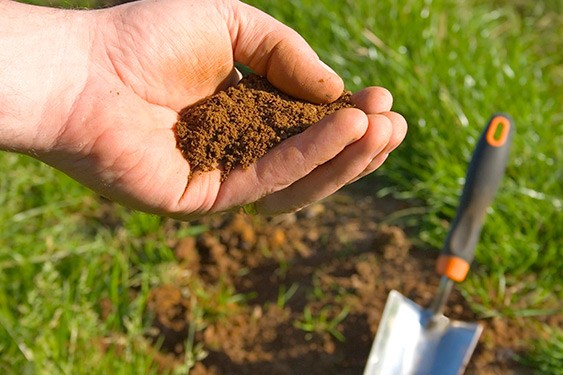
This training focuses on advanced approaches for estimating changes in soil organic carbon (SOC), a key indicator of soil health and carbon cycling. It introduces the integration of sampling theory and Geostatistics to provide statistically robust methods for SOC stock change estimation and prediction. Through a combination of conceptual explanations and hands-on exercises in R, participants will learn how to design representative sampling strategies, quantify estimation uncertainty, and apply geostatistical techniques to model spatial variability and prediction uncertainty. Designed for researchers, graduate students, and professionals in soil science and environmental monitoring, this training supports accurate carbon accounting and strengthens the scientific basis for climate change mitigation and soil management strategies.
Prerequisites:
Participants are required to bring a laptop with R version 4.4.3 or higher installed. Specific R packages must be installed in advance; an installation and testing script will be shared prior to the conference. Participants are expected to have basic knowledge of statistics and prior experience using R.
Trainer:

Gerard Heuvelink

Alexandre Wadoux
Predict Soil Properties with Spectroscopy – A Machine Learning Hackathon

This training is designed for those who wish to strengthen their machine learning skills. It combines hands-on learning with a hackathon, where participants work in teams to develop machine learning models for predicting soil properties using spectroscopy data. Teams will receive a shared dataset of soil spectra and reference measurements. The goal is to build models that accurately predict soil properties, with teams ranked based on their performance on an unseen test dataset.
Through hands-on experimentation, participants will gain practical experience in spectral preprocessing (e.g., dimensionality reduction), machine learning techniques (e.g., tabular foundation models), and validation strategies (e.g., leakage-free training). By combining advanced statistical techniques with collaborative problem-solving, this training fosters innovation in soil data analysis and supports the development of rapid and accurate soil assessment tools for precision agriculture and sustainable land management
Prerequisites:
Participants are required to bring a laptop with R or Python installed. Having a basic knowledge of machine learning would be helpful.
Trainer:

Viacheslav Barkov
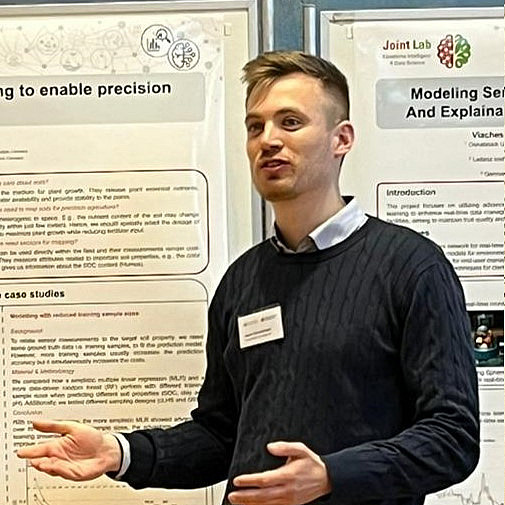
Jonas Schmidinger
Soil Security Training Workshop
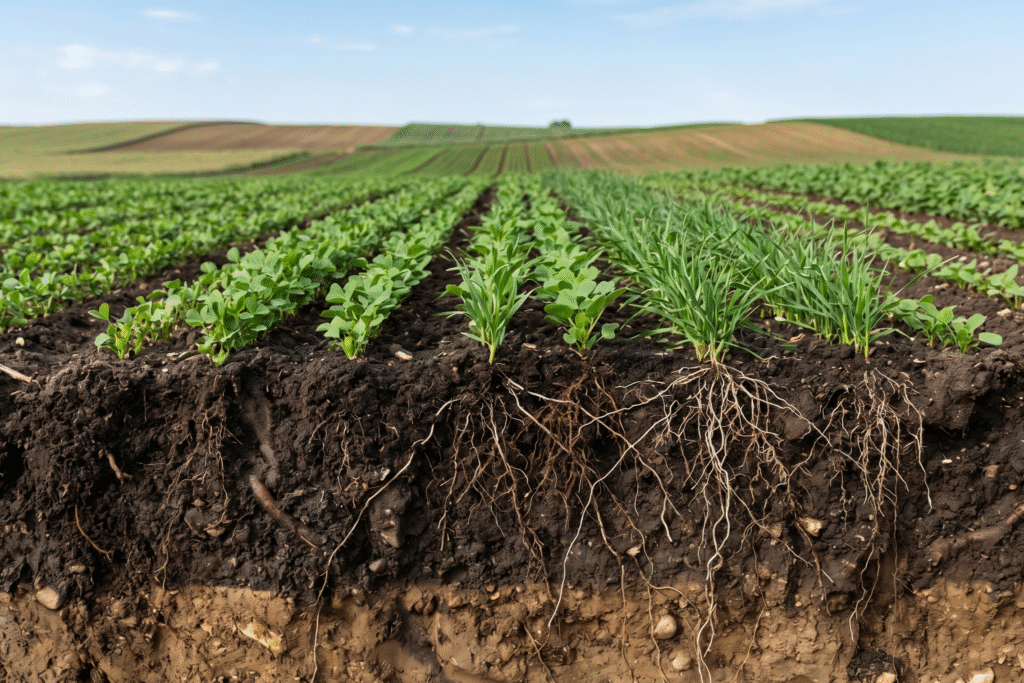
This training introduces the concept of soil security and its practical application through the Soil Security Assessment Framework (SSAF), a comprehensive approach for evaluating soil systems across multiple dimensions. Despite its conceptual strength, applying SSAF in real-world contexts remains challenging for many practitioners. Through case study-based learning, participants explore how SSAF can be used to assess soil systems by examining its five key dimensions. Gain practical experience in interpreting soil data, analysing indicators, and synthesizing findings to support evidence-based decision-making. Designed for researchers and professionals in soil and environmental sciences, this training builds capacity for assessing, valuing, and managing soil resources, supporting sustainable land management and informed policy development.
Prerequisites:
Participants are required to bring a laptop with R version 4.4.3 or higher installed. Specific R packages must be installed in advance; an installation and testing script will be shared prior to the conference. Participants are expected to have basic knowledge of statistics and prior experience using R.
Trainer:

Wartini Ng

Ho Jun Jang

Alex McBratney